Cooling Tower Fill Design Explained: How Corrugated Structure Improves Heat Transfer
Cooling Tower Fill Design Explained: How Corrugated Structure Improves Heat Transfer
When people talk about cooling tower performance, they often focus on fan capacity, water flow rate, or approach temperature. But in many cases, the real work happens inside the tower fill.
The design of Cooling Tower Fill directly affects how efficiently water and air come into contact. A well-designed fill creates more surface area, improves water distribution, and gives heat more opportunity to transfer from water to air.
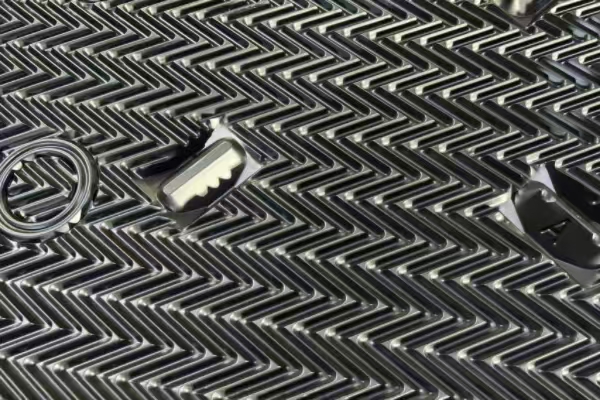
This is why corrugated structures are widely used in modern film fill cooling tower systems. The shape may look simple at first glance, but the geometry behind a good Corrugated fill design plays a major role in cooling efficiency.
From an engineering point of view, cooling tower fill is not just plastic sheets stacked together. The profile, flute angle, spacing, surface texture, and assembly method all influence how the cooling tower performs.
Why Cooling Tower Fill Structure Matters So Much
The main job of tower fill is to create effective contact between circulating water and incoming air.
Without fill, water would simply fall through the cooling tower relatively quickly. The contact time between water and air would be limited, which means less opportunity for evaporation and heat transfer.
A properly designed Cooling Tower Media changes this process. Instead of allowing water to fall straight down, the fill spreads water into thin films and guides it across multiple surfaces.
This creates three important advantages:
- More heat transfer surface area
- Longer water-air contact time
- Better distribution of water throughout the fill pack
In simple terms, good fill design makes the same volume of water work harder before leaving the tower.
How Corrugated Fill Improves Heat Transfer
The corrugated structure is one of the most important design features in modern Film Fill.
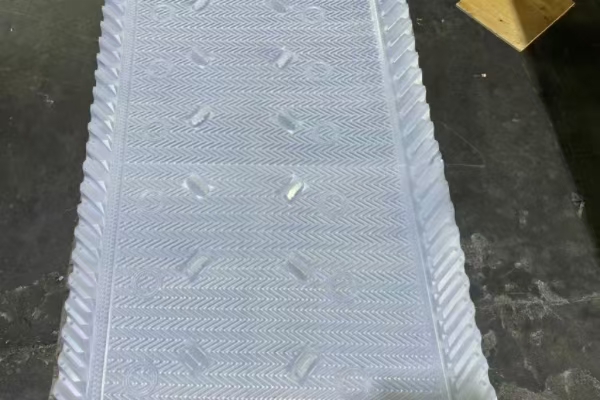
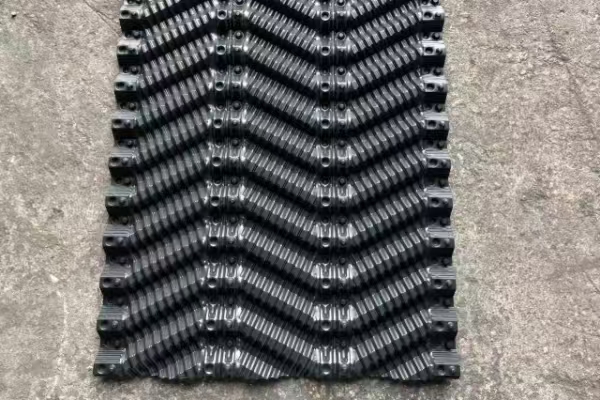
When PVC or PP sheets are thermoformed into corrugated patterns and assembled together, they create a network of small channels. These channels guide both air and water through the fill section.
The purpose is not simply to create a complicated shape. The structure is designed to increase the effective contact area while maintaining enough open space for airflow.
A typical corrugated cooling fill structure works in several ways.
1. It Increases the Effective Surface Area
A flat sheet provides limited surface area. Once the sheet is formed into a corrugated profile, the total surface area increases significantly within the same installation volume.
More surface area means more opportunity for water to spread into thin films.
This is one of the reasons Corrugated fill has become a common choice for industrial cooling towers where compact space and cooling efficiency are both important.
2. It Creates Thin Water Films
Thin water films are much easier to cool than large streams of water.
When water flows across the corrugated surface, it spreads into a thin layer. This increases exposure to moving air and improves evaporation.
Think about drying a wet surface. A thin layer of water dries much faster than a deep puddle. The same basic principle applies inside a cooling tower.
The goal of Cooling Tower Fill design is therefore not just to slow down water. It is to distribute water efficiently across as much surface area as possible.
3. It Creates Turbulence and Repeated Mixing
Water flowing through corrugated fill does not simply travel in a straight line.
The alternating corrugation pattern causes water to repeatedly change direction. At the same time, air passes through the channels created between adjacent sheets.
This repeated interaction improves mixing between air and water.
A well-designed fill profile can increase turbulence without creating excessive airflow resistance. This balance is important because too much restriction can increase fan energy consumption.
That is why two fill products with a similar appearance may perform very differently in actual operation.
The Balance Between Heat Transfer and Air Resistance
One common misunderstanding is that smaller channels always mean better cooling performance.
Not necessarily.
A smaller flute spacing can increase surface area, but it can also increase airflow resistance and make the fill more sensitive to fouling.
On the other hand, a larger channel provides better resistance to dirt and biological growth but may offer less heat transfer surface.
So when selecting tower fill, engineers usually need to balance several factors:
- Heat transfer efficiency
- Airflow resistance
- Water quality
- Operating temperature
- Fouling risk
- Maintenance requirements
There is no single corrugated structure that is perfect for every cooling tower.
Corrugated Fill Design in Counter Flow Cooling Towers
In a counter flow cooling tower, air moves upward while water flows downward through the fill.
This creates strong interaction between the two flows, but it also means the fill must be designed carefully to avoid excessive pressure drop.
For this type of system, the flute structure and spacing need to provide enough surface area while keeping the air passages sufficiently open.
For projects involving counter flow tower designs, engineers often select specialized Counter flow fill media designed around the airflow and water distribution characteristics of vertical-flow cooling towers.
During replacement projects, it is also important not to assume that any fill with the same thickness will deliver the same performance. Profile geometry and installation height can make a noticeable difference.
Corrugated Fill Design in Cross Flow Cooling Towers
Cross flow cooling towers operate differently. Water generally moves downward while air enters horizontally through the fill.
This requires a different approach to water distribution and airflow management.
In cross flow systems, the fill must support uniform water flow while allowing air to pass horizontally through the structure.
The geometry of the corrugated sheets therefore needs to match the tower design rather than simply copying a counter flow fill profile.
Using the wrong structure may lead to uneven water distribution, increased pressure drop, or reduced cooling efficiency.
What Makes a Good Corrugated Cooling Tower Fill?
From manufacturing experience, a good cooing fill is not defined by appearance alone.
Several design and production details should be considered.
Sheet Profile Accuracy
The corrugated pattern should remain consistent across the entire production batch.
Small deviations in sheet forming can affect the spacing between sheets and eventually change airflow characteristics.
Proper Sheet Thickness
Thicker material may improve mechanical strength, but thickness alone does not determine cooling performance.
The material needs to provide enough rigidity for installation and operation without unnecessarily increasing weight or material cost.
Correct Flute Spacing
Flute spacing is closely related to both cooling efficiency and fouling resistance.
Cleaner water systems can usually use higher-efficiency structures with smaller passages. Systems with poor water quality may require wider spacing to reduce blockage risk.
Reliable Bonding or Assembly Design
Individual fill sheets must maintain stable spacing after installation.
If the fill structure deforms or collapses, airflow channels can become restricted and cooling performance may drop quickly.
Material Selection: PVC or PP?
The corrugated structure is important, but material selection also matters.
PVC cooling tower fill is widely used because it provides good forming performance, chemical resistance, and cost efficiency for many industrial cooling applications.
For higher-temperature operating conditions, PP materials may be considered.
The correct material should be selected based on actual operating conditions rather than simply choosing the lowest-cost option.
For example, when evaluating material options for replacement projects, a properly designed PVC cooling tower fill can provide a practical balance between cooling performance, durability, and overall project cost.
Why Fill Geometry Matters During Cooling Tower Replacement
Many cooling tower replacement projects focus mainly on dimensions.
Customers often ask questions like:
- What is the width?
- What is the height?
- What is the thickness?
These dimensions are important, but they are not enough.
During a cooling tower replacement, the internal structure of the fill should also be evaluated.
A replacement fill with the same external dimensions but a completely different corrugated profile may change:
- Cooling capacity
- Air pressure drop
- Fan power consumption
- Fouling tendency
- Water distribution behavior
Before ordering replacement fill, it is always a good idea to check the original fill profile, operating temperature, water quality, and tower type.
If possible, providing a sample or photo of the existing fill can help avoid selecting a structure that looks similar but performs differently.
Common Problems Caused by Poor Fill Design Selection
Choosing the wrong fill structure does not always cause an immediate failure. Sometimes the cooling tower continues operating, but efficiency gradually decreases.
Common issues include:
- High airflow resistance
- Uneven water distribution
- Frequent fouling and blockage
- Reduced cooling capacity
- Increased fan energy consumption
- Premature deformation of fill sheets
This is why fill selection should be treated as an engineering decision rather than simply a purchasing decision.
A Simple Way to Evaluate Cooling Tower Fill Design
If you are comparing different suppliers, it helps to look beyond product photos.
You can ask a few practical questions:
- What is the flute height and spacing?
- What material is used?
- What operating temperature is recommended?
- Is the design intended for counter flow or cross flow towers?
- How does the structure handle fouling?
- Can the fill dimensions be customized?
- Is the profile consistent across production batches?
These questions usually provide more useful information than simply comparing price per cubic meter.
Final Thoughts
The corrugated structure inside a cooling tower may not look complicated, but its design has a direct impact on heat transfer efficiency.
Good Cooling Tower Media increases water surface area, creates thin water films, improves air-water interaction, and maintains an effective balance between heat transfer and airflow resistance.
When selecting a Cooling Tower Fill, especially for retrofit or replacement projects, it is worth looking beyond external dimensions. The internal geometry, flute spacing, material, and operating conditions should all be considered together.
A properly selected film fill cooling tower structure can help improve cooling efficiency and provide more stable long-term operation. In practical projects, the best solution is usually the one matched to the tower design and water conditions—not simply the fill with the most complicated-looking pattern.
Need Help Selecting the Right Cooling Tower Fill?
If you are planning a new project or replacing existing cooling tower media, our team can help evaluate fill structure, material, dimensions, and application requirements.