Cooling Tower Fill Dimensions: How to Measure and Order Replacement Fill Correctly
Cooling Tower Fill Dimensions: How to Measure and Order Replacement Fill Correctly
Ordering cooling tower fill sounds simple until the replacement material arrives and you find out that the blocks do not fit the tower, the height is wrong, or the original fill was designed for a completely different airflow arrangement.
This happens more often than you might think.
When a cooling tower needs new fill, many buyers start by asking for a price per cubic meter. That is useful, but it is not enough. Before ordering Cooling Tower Fill, you need to know the actual dimensions, fill type, material, installation arrangement, and operating conditions.
Whether you are replacing old film fill, looking for a film fill cooling tower solution, or replacing damaged Corrugated Fill, getting the measurements right can save a lot of time and unnecessary freight costs.
Why Cooling Tower Fill Dimensions Matter
Cooling tower fill is not simply a plastic sheet packed inside the tower. Its dimensions and arrangement directly affect how water spreads, how air moves through the fill, and how much effective contact area is available for heat transfer.
A replacement fill that is slightly different from the original may still physically fit inside the tower, but that does not necessarily mean it will perform correctly.
For example, changing the fill height can alter the available heat transfer area. Changing the sheet spacing or corrugation can affect pressure drop and airflow. Using the wrong fill arrangement can also create poor water distribution or increase the risk of fouling.
So when someone asks, "What size cooling tower fill do I need?", my first recommendation is always the same: measure the existing fill and the available fill space before discussing the final quantity and price.
What Dimensions Should You Measure?
When measuring replacement tower fill, there are several dimensions worth recording. Do not rely on only one measurement such as length and width.
1. Fill Block Length
Measure the longest horizontal dimension of one fill block.
If the fill consists of several smaller blocks installed side by side, measure one complete block rather than assuming that the entire fill section is one piece.
For example, you may find an arrangement such as:
- 1000 mm × 500 mm blocks
- 1000 mm × 1000 mm blocks
- 1200 mm × 600 mm blocks
- Custom-sized blocks designed around the tower structure
There is no universal block dimension that works for every cooling tower. The correct size depends on the tower basin, support grid, air inlet arrangement, and internal structure.
2. Fill Block Width
Next, measure the width of the block.
This is particularly important when several blocks are arranged across the tower. A small difference in block width can create gaps or interfere with structural supports.
For replacement projects, it is often better to divide the complete fill area into several practical blocks rather than trying to reproduce one extremely large block.
3. Fill Height
Fill height is one of the most important measurements.
Measure the actual height of the installed fill from the bottom support level to the top of the fill section. If the fill is installed in multiple layers, record the height of each layer separately.
For example:
- One 900 mm fill section
- Two 450 mm layers
- Three 300 mm layers
The best arrangement depends on the cooling tower design and how the fill is supported.
Do not automatically assume that the new fill should have exactly the same height as the old fill. If the original material has been compressed, damaged, or heavily fouled, the measured height may not represent the original design.
Don't Forget the Fill Type
Dimensions are only half of the replacement decision. You also need to identify what type of fill is currently installed.
The most common categories include film fill and splash fill. In many modern industrial cooling towers, film fill cooling tower systems are widely used because the thin water film provides a large contact area between water and air.
Within film fill systems, the surface pattern and sheet spacing can also be different.
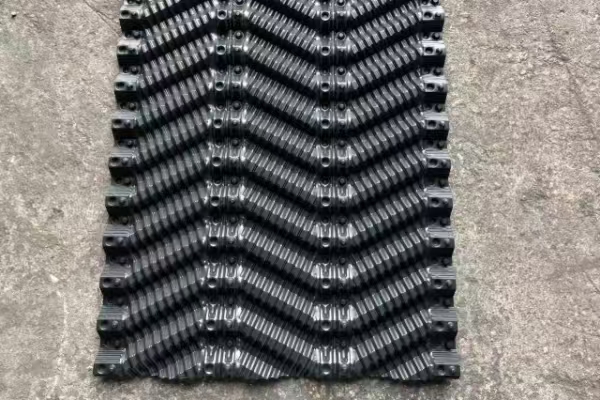
Corrugated Fill uses formed sheets to create channels for water and air. The exact corrugation pattern influences the contact area, airflow resistance, and fouling characteristics.
That is why simply saying "I need PVC tower fill" is usually not enough information for a manufacturer.
PVC or PP: Which Cooling Tower Fill Material?
Material selection is another important part of replacement planning.
PVC Cooling Tower Fill is widely used in industrial and commercial cooling tower applications because it provides a good balance between cost, rigidity, temperature resistance, and chemical compatibility for many normal operating conditions.
PP can be considered when the operating environment requires higher temperature resistance or when the water chemistry and process conditions make PP a better choice.
However, the material should not be selected only because the original fill was PVC or PP. Always consider the actual water temperature, chemical conditions, fouling level, and tower application.
For projects where the existing PVC fill has reached the end of its service life, you can review our PVC Cooling Tower Fill options and compare the material and structure with your existing fill.
How to Measure a Cooling Tower Before Ordering Replacement Fill
If you are standing beside the cooling tower with a tape measure, I would suggest following this order rather than measuring randomly.
Step 1: Measure the Total Fill Area
First determine the approximate length and width of the complete fill section.
If the tower has multiple cells, measure each cell separately. Do not assume every cell has exactly the same dimensions, especially on older towers that have been modified over the years.
Step 2: Measure the Available Fill Height
Measure from the fill support structure to the top of the available fill space.
Leave room for water distribution components, drift eliminators, spray pipes, beams, nozzles, or other internal components where necessary.
Step 3: Count the Existing Fill Blocks
Count how many blocks are currently installed in each row and layer.
This gives the manufacturer a useful reference for designing a replacement arrangement.
Step 4: Check the Support Structure
This step is often forgotten.
Look at the support beams, grid, hanging rods, clips, and other components that physically carry the fill. A new fill block must work with the existing support arrangement.
If the original fill has collapsed, do not measure only the collapsed blocks. Check the actual support structure and available installation space.
Step 5: Take Photos
A few clear photographs can be extremely helpful.
Take photos of:
- The complete fill section
- One fill block from the side
- The fill sheet surface and corrugation
- The bottom support structure
- The top of the fill section
- The water distribution system above the fill
For an experienced cooling tower fill supplier, these photos can often reveal information that a simple dimension list cannot.
Cooling Tower Fill Measurement Example
Suppose an industrial cooling tower has a fill area approximately 4 meters long and 3 meters wide, with an available fill height of 1.2 meters.
That gives an approximate fill volume of:
4 m × 3 m × 1.2 m = 14.4 m³
But do not immediately order exactly 14.4 m³ of tower fill.
You still need to consider the actual block dimensions, support structure, installation gaps, cell configuration, and whether the replacement fill will be supplied as individual sheets or assembled blocks.
The final quantity should normally be confirmed after the block arrangement has been designed.
Why Replacement Fill Is Often Supplied as Blocks
One practical issue that surprises first-time buyers is transportation.
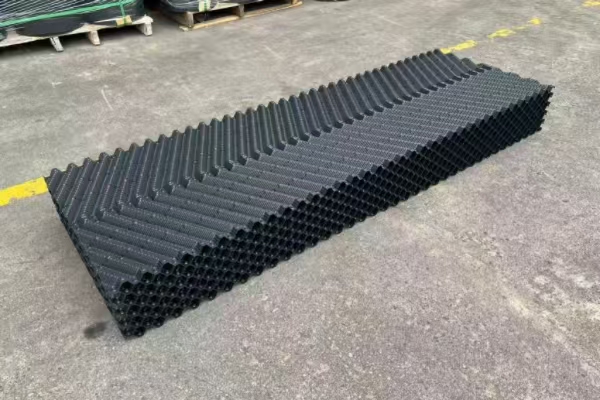
Individual film fill sheets take up relatively little space. Once they are assembled into large fill blocks, however, the shipping volume can increase significantly.
For this reason, replacement Cooling Tower Media may be supplied in a format that allows efficient transportation and final assembly at the project site.
This is particularly important for international projects. A technically good fill can become unnecessarily expensive if the packaging and shipping volume are not considered from the beginning.
For larger industrial projects, it is therefore worth discussing the block arrangement and packing method with the supplier before placing the final order.
When Should You Replace Cooling Tower Fill?
Dimensions are important, but there is another question: does the fill actually need to be replaced?
If the existing fill is only lightly dirty and still mechanically sound, cleaning may be enough. But replacement becomes more reasonable when the fill has serious deformation, cracking, brittleness, biological growth, heavy scale, or structural collapse.
Typical warning signs include:
- Large areas of collapsed or deformed fill
- Cracked or brittle PVC sheets
- Heavy mineral scale that cannot be effectively removed
- Persistent algae or biological fouling
- Blocked water channels
- Significant loss of airflow through the fill
- Uneven water distribution
- Reduced cooling performance after normal maintenance
If several of these problems appear at the same time, installing new cooling tower replacement fill may be more economical than repeatedly cleaning and repairing the old media.
How Cooling Tower Fill Blocks Should Be Ordered
For a replacement project, I recommend sending the supplier a simple measurement sheet rather than just writing "Please quote cooling tower fill."
Your request can include:
- Cooling tower type: counter flow or cross flow
- Number of tower cells
- Fill area length
- Fill area width
- Available fill height
- Existing fill block dimensions
- Number of blocks
- Existing fill material
- Water temperature
- Operating water quality
- Photos of existing fill
- Required delivery quantity
This information allows the manufacturer to recommend a practical replacement arrangement instead of simply quoting a generic product.
If your project requires multiple replacement blocks, you can also review our Cooling Tower Fill Blocks to see how fill can be supplied in different block configurations.
Don't Copy the Old Fill Blindly
One mistake I often see in replacement projects is treating the old fill as the perfect specification.
Sometimes it is. Sometimes it is not.
A cooling tower may have been operating for ten or twenty years. During that time, the water quality may have changed, the process load may have changed, and the tower may have been modified.
The original fill may also have been replaced before, without the current operator having complete records.
So if you are replacing an old Film Fill, use the existing fill as an important reference, but also look at the actual operating conditions of the tower today.
Questions to Ask Your Cooling Tower Fill Supplier
Before placing an order, I would ask the supplier a few simple questions:
- Can you manufacture the fill according to our measured dimensions?
- Which fill type is recommended for our tower design?
- Is the material PVC or PP, and why?
- What operating temperature is the material suitable for?
- Can you supply the fill in the required block dimensions?
- How should the blocks be installed on the existing support structure?
- How will the fill be packed for international shipment?
- Can you review our drawings or photos before production?
A good supplier should be willing to discuss these details before asking you to place the order. That conversation can prevent a surprisingly expensive mistake later.
Cooling Tower Fill Replacement Checklist
Before sending your inquiry, check the following:
- ✔ Fill length measured
- ✔ Fill width measured
- ✔ Fill height measured
- ✔ Existing block dimensions recorded
- ✔ Number of blocks counted
- ✔ Tower type confirmed
- ✔ Existing fill material identified
- ✔ Water temperature provided
- ✔ Water quality or fouling conditions described
- ✔ Support structure photographed
- ✔ Existing fill photos attached
If you can provide most of this information, the supplier can usually give you a much more useful recommendation than they could from a simple request for "cooling fill."
Final Thoughts: Measure First, Order Second
Replacing cooling tower fill is not difficult, but the measurement stage deserves more attention than it usually gets.
Before ordering Cooling Tower Fill, check the length, width, height, block arrangement, support structure, fill type, material, and operating conditions. For a film fill cooling tower, also pay attention to the fill sheet pattern and airflow arrangement rather than focusing only on the outside dimensions.
If you are replacing old Corrugated Fill or another type of tower fill, clear measurements and photos are often enough for a manufacturer to evaluate the replacement requirements.
And if you are not sure whether the existing material should simply be cleaned or completely replaced, share the operating information and photos with your supplier before making the decision.
Need Help With Your Cooling Tower Fill Replacement?
If you already have the dimensions, drawings, or photos of your existing fill, send them to us. We can review the information and help confirm a suitable fill type, material, block size, and replacement quantity for your cooling tower.
```