Cooling Tower Fill Inspection: What Should Engineers Check
Cooling Tower Fill Inspection: What Should Engineers Check?
When a cooling tower starts losing performance, the first thing many people look at is the fan, pump, or water flow. But the Cooling Tower Fill inside the tower deserves just as much attention.
The fill is where most of the heat and mass transfer happens. If the sheets are dirty, damaged, deformed, or poorly distributed, the tower may still be running normally while its actual cooling capacity is slowly getting worse.
A proper inspection does not have to be complicated. An experienced engineer can usually learn a lot by checking the condition of the film fill cooling tower system, water distribution, airflow path, and physical condition of the fill before deciding whether cleaning or cooling tower replacement is necessary.
Why Is Cooling Tower Fill Inspection Important?
Cooling tower fill operates in a difficult environment. It is continuously exposed to water, chemicals, suspended solids, biological growth, temperature changes, and airflow.
Over time, these conditions can change the surface of the fill and the way water flows through it. A small amount of dirt may not cause an obvious problem, but heavy fouling can reduce the effective contact area between air and water and increase resistance to airflow.
This is why checking the tower fill should be part of regular cooling tower maintenance rather than something done only after cooling performance has already dropped.
What Should Engineers Check During a Cooling Tower Fill Inspection?
1. Look for Dirt, Scale and Biological Fouling
The first check is usually the simplest: look at the surface of the fill.
Engineers should check for mud, scale, algae, slime, biological deposits, and other material attached to the sheets. Pay particular attention to areas where water distribution is poor or where suspended solids tend to accumulate.
Heavy fouling can block the passages between corrugated sheets. Once these passages become restricted, water distribution and airflow can both be affected.
For towers operating with relatively dirty water, an anti-fouling cooling tower fill can sometimes be considered during a future replacement project.
Learn more about Anti Fouling Fill Media
2. Check Whether the Fill Sheets Are Deformed
Physical deformation is another important warning sign.
Look for collapsed channels, bent sheets, distorted flute patterns, sagging sections, or areas where several sheets have pressed together. These problems reduce the open passage available for air and water.
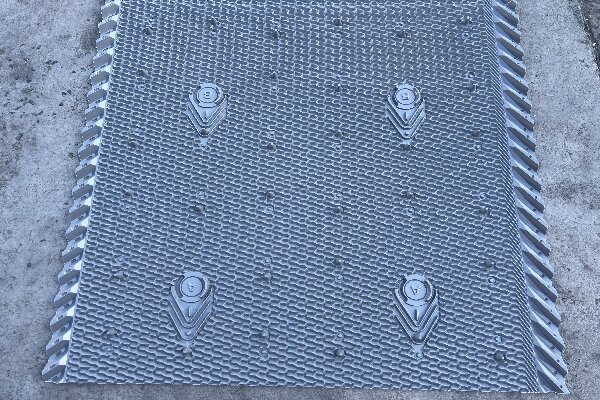
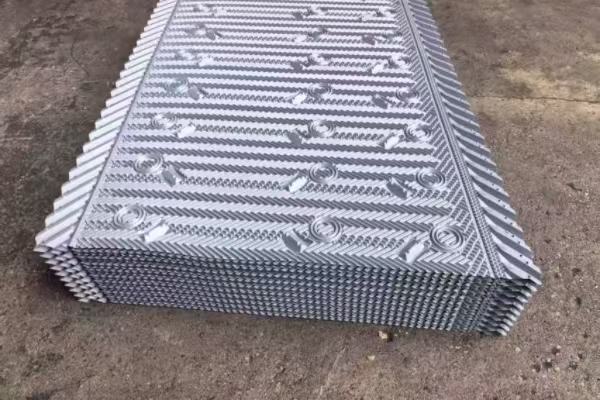
In a film fill cooling tower, the geometry of the sheets is important because it controls how water spreads across the surface and how air moves through the fill.
If the original flute structure has changed significantly, simply washing the fill may not restore the original cooling performance.
3. Check for Cracks, Brittleness and Broken Sheets
Plastic cooling tower fill can become brittle after long-term exposure to heat, chemicals, ultraviolet radiation, or repeated operating cycles.
During inspection, check for cracked sheets, broken edges, brittle material, and pieces of fill that have fallen into the basin.
If the fill breaks easily when lightly handled, the problem is not just surface contamination. It may indicate material aging, excessive temperature exposure, or long-term chemical attack.
4. Check the Spacing Between the Sheets
The spacing between fill sheets should remain reasonably consistent.
If sheets have moved, collapsed, or become stuck together, the effective contact area between air and water can change. At the same time, the pressure drop through the fill may increase.
This is especially important for Corrugated Fill, because its flute geometry is designed to create a controlled path for air and water.
When replacing fill, engineers should not only consider the dimensions of the old material. Flute height, sheet spacing, material, water quality, airflow, and tower design should all be considered together.
5. Check Water Distribution Above the Fill
Sometimes the fill looks acceptable, but the real problem is above it.
Inspect spray nozzles, distribution pipes, headers, and basins for blocked nozzles, uneven water flow, or dry areas.
A film fill system depends on reasonably uniform water distribution. If one section receives too much water while another section receives too little, the fill cannot be used effectively.
This is one reason engineers should inspect the water distribution system together with the Cooling Tower Media, rather than treating the fill as an isolated component.
6. Look for Dry Areas Inside the Fill
After the tower has been operating, inspect whether water is reaching the fill evenly.
Large dry areas can indicate blocked nozzles, damaged distribution pipes, incorrect water flow, or poor installation. They can also indicate that the fill itself has shifted or collapsed.
Uneven wetting means part of the available fill surface is doing little useful work. In a cooling tower where the design depends heavily on film formation, this can have a noticeable effect on cooling performance.
7. Check the Fill Support Structure
Do not forget to inspect the structure supporting the fill.
Check support beams, grids, brackets, clips, and other components for corrosion, cracking, deformation, or excessive movement.
A damaged support system can cause the fill blocks to move or collapse. In some cases, the fill itself may still be in reasonable condition, but the supporting structure has become the weak point.
How Can Engineers Tell If Cooling Tower Fill Needs Cleaning or Replacement?
Not every dirty fill needs to be replaced.
If the sheets are still flexible, structurally sound, and correctly positioned, cleaning may be enough. After cleaning, the tower should be monitored to see whether temperature performance and water distribution return to an acceptable level.
Replacement becomes more reasonable when several problems appear together, such as:
- Severe or repeated fouling
- Collapsed or deformed fill channels
- Large numbers of cracked or brittle sheets
- Significant loss of fill surface area
- Persistent poor water distribution
- High airflow resistance
- Frequent fill failures after cleaning
- Long-term material aging
In other words, the decision should not be based only on how dirty the fill looks. Its physical condition and the tower's actual operating performance are more important.
Compare the Fill Condition With Cooling Tower Performance
A visual inspection tells you what the fill looks like. Operating data tells you whether the condition is actually affecting the tower.
Before and after inspection, engineers can compare cold water temperature, hot water temperature, ambient wet-bulb temperature, water flow, fan operation, and other available operating data.
If the fill looks heavily fouled and the tower is also showing a worsening approach temperature, reduced cooling capacity, or increasing airflow resistance, the fill condition becomes much more relevant.
This is a much better approach than replacing Cooling Tower Fill simply because it has been in service for a certain number of years.
What Should You Check Before Ordering Replacement Fill?
If inspection shows that replacement is necessary, avoid ordering new fill based only on the old sheet size.
Confirm the Tower Type
First determine whether the tower is a counter-flow or cross-flow design. The internal water and airflow arrangement is different, so the correct fill configuration can also be different.
Confirm Dimensions and Flute Geometry
Measure the existing fill carefully, including width, length, thickness, pitch, flute height, and block configuration where possible.
For replacement projects, matching the original dimensions is useful, but the new fill should also be checked against the tower's actual operating conditions.
Confirm Material Requirements
PVC and PP are commonly used for cooling tower fill, but the better choice depends on operating temperature, water chemistry, UV exposure, and the application.
For industrial applications, engineers should consider these conditions before selecting a new Cooling Tower Media rather than choosing material only by price.
For heavy-duty industrial applications, you can also see our Industrial Cooling Tower Fill options for different tower designs and replacement requirements.
Inspection Is Also a Good Time to Check for Design Problems
A fill inspection can reveal problems that were not originally caused by the fill itself.
For example, repeated fouling in one area may point to poor water distribution. Repeated deformation may indicate excessive temperature or insufficient support. High pressure drop may indicate that the selected fill geometry is not suitable for the actual airflow and water loading.
This is why experienced cooling tower engineers normally look at the complete system rather than simply asking, “Is the fill dirty?”
When Is Cooling Tower Fill Replacement the Better Choice?
There is a point where continued cleaning and repairing no longer makes economic sense.
If the fill has become brittle, badly deformed, heavily damaged, or repeatedly loses performance after cleaning, new fill can provide a more reliable solution.
For a cooling tower replacement project, the goal should not simply be to install something that fits into the old tower. The new fill should match the tower type, water quality, operating temperature, airflow, water loading, and expected service conditions.
That is where selecting the right film fill and fill geometry becomes important.
A Practical Cooling Tower Fill Inspection Checklist
For routine maintenance, engineers can use the following checklist:
- Check for mud, scale, algae and biological fouling.
- Check for cracked, brittle or broken sheets.
- Look for collapsed or deformed channels.
- Check whether sheet spacing remains consistent.
- Inspect the fill support structure.
- Check spray nozzles and water distribution.
- Look for dry areas and uneven wetting.
- Check for excessive airflow resistance.
- Compare current cooling performance with historical operating data.
- Decide whether cleaning, repair or replacement is the most practical option.
The Bottom Line
A good Cooling Tower Fill inspection is not just about looking for dirt. Engineers should check the fill's physical condition, sheet geometry, water distribution, support system, material aging, and actual cooling performance.
When the fill is still structurally sound, cleaning may be enough. When the material has become brittle, collapsed, severely fouled, or repeatedly causes performance problems, replacement is usually the more reliable solution.
For replacement projects, choosing the right tower fill is just as important as choosing the correct size. The right film fill cooling tower configuration can help restore water distribution, heat transfer performance, and reliable long-term operation.
If you are checking an existing tower and are not sure which type of fill should be used, you can contact us with your existing fill dimensions, tower type, operating temperature, water flow, or drawings. We can help review the application and suggest a suitable cooling fill solution.