Cooling Tower Fill Replacement Guide: How to Measure, Select and Order the Right Fill
Cooling Tower Fill Replacement Guide: How to Measure, Select and Order the Right Fill
Replacing old cooling tower fill sounds simple until you actually have to order it. Then the usual questions start coming up: What size do we need? Should we use the same material? Is the old fill counter flow or cross flow? Do we need complete fill blocks or individual sheets?
We have seen many replacement projects delayed simply because the wrong dimensions were provided at the beginning. The good news is that you do not need a complicated engineering calculation just to identify replacement Cooling Tower Fill. In most cases, a few measurements and some basic information about the tower are enough to get the process moving.
This guide explains how experienced cooling tower engineers usually approach a fill replacement project, from measuring the existing media to selecting the right tower fill and ordering it from a supplier.
Why Cooling Tower Fill Replacement Needs More Attention Than You Might Expect
Cooling tower fill is not just plastic material placed inside the tower. It is the part that creates the large contact area between water and air, allowing heat to transfer efficiently.
When the fill becomes badly fouled, cracked, deformed or blocked, the tower may gradually lose cooling performance. Operators may notice higher outlet water temperatures, uneven water distribution or increasing airflow resistance.
At that point, replacing the Cooling Tower Media can be more practical than repeatedly cleaning heavily damaged fill.
But there is one important point: do not order replacement fill based only on the cooling tower's tonnage or model number. The actual fill dimensions and operating conditions are much more useful.
Step 1: Identify the Cooling Tower Type First
Before measuring anything, find out what type of tower you have.
The two configurations you will come across most often are counter flow and cross flow.
Counter Flow Cooling Tower
In a counter flow tower, hot water moves downward while air moves upward through the fill. The water and air travel in opposite directions.
Counter flow towers commonly use structured film fill because the design allows a large amount of water-air contact within a relatively compact space.
If your tower is a counter flow design, you can compare the existing media with our Counter flow fill media when looking for a replacement.
Cross Flow Cooling Tower
Cross flow towers work differently. Air moves horizontally through the fill while water falls vertically.
The internal layout, water distribution system and fill arrangement are therefore different from a counter flow tower.
This is why counter flow and cross flow fill should not simply be treated as interchangeable products, even if the sheets look similar.
Step 2: Measure the Existing Cooling Tower Fill
This is probably the most important part of the replacement process.
If you can safely remove one section of the old fill, measure the actual fill rather than estimating the dimensions from the tower itself.
For a typical fill sheet or fill block, record:
- Length
- Width
- Height
- Sheet thickness
- Number of sheets per block, if applicable
- Number of blocks required
Do not worry if the dimensions are not perfectly standard. Cooling towers built by different manufacturers can use different fill dimensions, and replacement projects often require customized sizes.
Measure the Fill Block, Not Just the Tower Opening
This is an easy mistake to make.
The available space inside the tower does not necessarily equal the actual fill block size. There may be support frames, gaps, water distribution components and access areas that need to be considered.
If possible, measure an existing fill block from several positions. If all measurements are consistent, you have a much better reference for the replacement order.
Step 3: Take Photos Before Removing the Old Fill
A few clear photographs can save a surprising amount of back-and-forth communication.
Take photos of:
- The complete fill installation
- The side of the fill block
- The top and bottom structure
- The corrugation pattern
- The support frame
- Any damaged or deformed areas
If you are contacting a manufacturer for the first time, send the photos together with the dimensions. An experienced supplier can often identify the general fill structure much faster this way.
Step 4: Check the Existing Fill Material
Next, find out what the old fill is made from.
For many industrial and commercial applications, PVC cooling tower fill is commonly used. Polypropylene, or PP, is another important option, especially when operating conditions require different temperature or chemical resistance characteristics.
If the old fill lasted for many years without material-related problems, keeping the same material may be perfectly reasonable.
On the other hand, if the old fill repeatedly deformed or deteriorated because of high temperature, it may be worth reviewing the material before ordering the replacement.
PVC Cooling Tower Fill
PVC is widely used for film fill because it provides a good balance of cost, rigidity, chemical resistance and cooling performance for many applications.
For conventional operating conditions, PVC cooling tower fill is often a practical replacement choice.
PP Cooling Tower Fill
PP can be considered for applications where higher temperature resistance or specific chemical compatibility is required.
If your existing PVC fill has suffered from repeated heat-related deformation, it is worth discussing the operating temperature with the supplier before simply ordering another batch of the same material.
Step 5: Look Closely at the Fill Structure
Two fill products can have the same dimensions and still perform differently.
The reason is the internal structure.
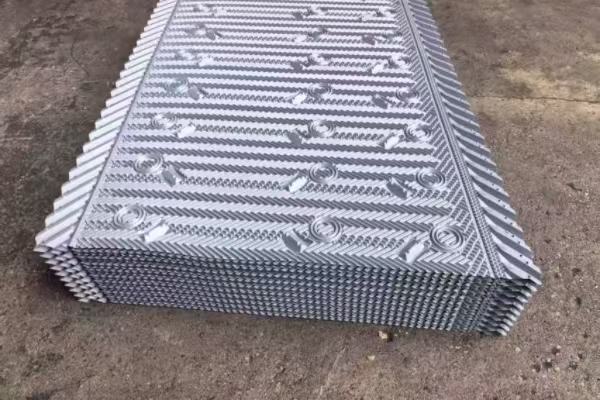
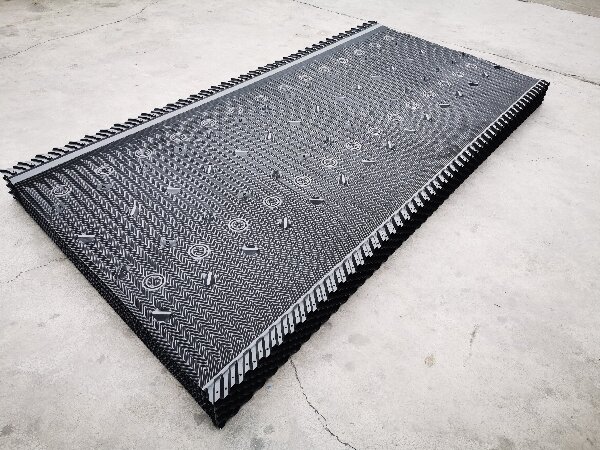
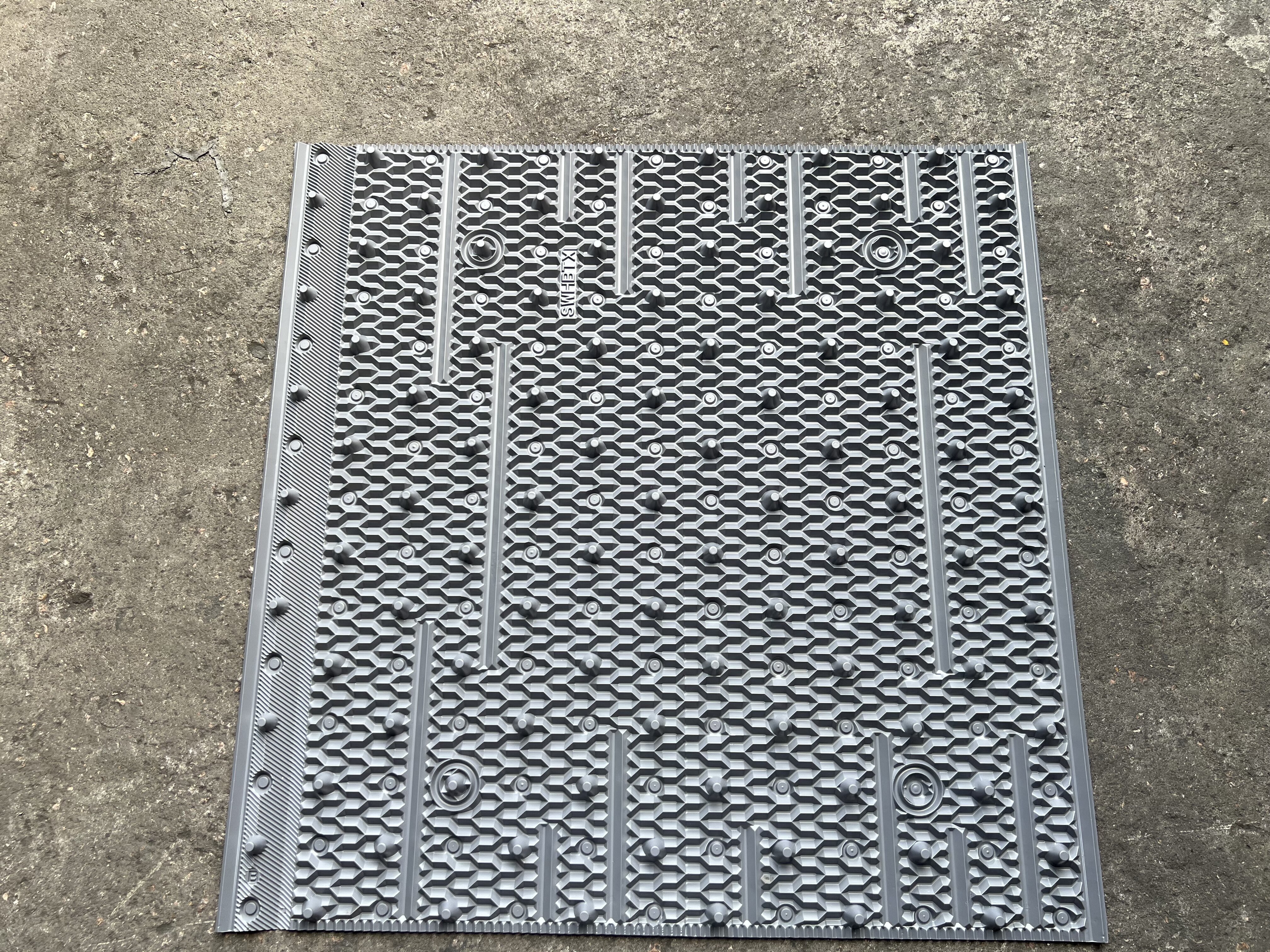
Film fill uses formed sheets to spread water over a large surface area. The corrugation pattern creates water and air passages while encouraging the water to remain in contact with the fill surface.
This is why terms such as film fill cooling tower, Corrugated Fill and Cooling Tower Fill are often used when discussing structured plastic media.
When replacing an existing product, pay attention to:
- Corrugation angle
- Flute height
- Sheet thickness
- Sheet spacing
- Surface pattern
- Block arrangement
A product that looks almost identical from a distance may have a different internal geometry.
Step 6: Decide Whether You Need Film Fill or Another Fill Structure
Film fill is a good choice for many cooling towers, particularly where the circulating water is reasonably clean.
However, water quality should not be ignored.
If the water contains a large amount of suspended solids, algae, scale or other contaminants, narrow passages inside some film fill designs can become blocked over time.
In these situations, the right question is not simply:
"Which fill has the highest surface area?"
A better question is:
"Which fill will maintain good cooling performance under our actual water conditions?"
This is one of the reasons experienced cooling tower operators look at both thermal performance and fouling resistance when choosing replacement media.
Step 7: Check the Operating Temperature
Temperature is another important point that should be discussed before ordering replacement fill.
Do not provide only the average operating temperature if the tower occasionally experiences significantly higher temperatures.
Ideally, provide:
- Normal inlet water temperature
- Maximum inlet water temperature
- Normal outlet water temperature
- Cooling range
- Ambient conditions, where available
This information helps the supplier determine whether the existing material is appropriate or whether another material should be considered.
Step 8: Check Water Quality and Fouling Conditions
If your previous fill failed much earlier than expected, water quality may be part of the reason.
Look for signs such as:
- Heavy scale
- Algae growth
- Mud or sediment
- Oil contamination
- Blocked air passages
- Uneven water distribution
Sometimes the problem is not the quality of the fill itself. The water treatment system may simply not be keeping up with the operating conditions.
Replacing the media without addressing the original fouling problem can lead to the same situation again.
Step 9: Decide Between Individual Sheets and Complete Fill Blocks
When ordering replacement media, you may be offered individual fill sheets or assembled fill blocks.
The best option depends on your installation method, labor availability, transportation requirements and tower design.
For many replacement projects, complete cooling tower fill blocks make installation more straightforward because the fill can be supplied in modules designed for the existing support structure.
For projects where the customer handles assembly locally, individual sheets may offer more flexibility during transportation and installation.
Before ordering, make sure the supplier understands whether you require sheets, blocks or another assembly configuration.
Step 10: Confirm the Quantity Carefully
Once the dimensions are confirmed, calculate the required volume and number of modules.
Do not estimate the quantity only from the tower's overall footprint.
Check the actual fill area and available installation height, including support frames and access requirements.
For larger replacement projects, it is also worth confirming how the fill will be packed for transportation. Cooling tower fill has a large volume compared with its weight, so packaging can have a noticeable impact on shipping cost.
What Information Should You Send to a Cooling Tower Fill Manufacturer?
If you want to receive an accurate quotation without several rounds of questions, send as much of the following information as possible:
- Cooling tower type
- Counter flow or cross flow
- Existing fill dimensions
- Fill material
- Fill thickness
- Operating temperature
- Water flow rate
- Water quality
- Required quantity
- Photos of the existing fill
- Delivery destination
If you do not know some of these details, that is fine. Start with the dimensions and photographs. A good supplier should be able to help identify the remaining information.
Common Mistakes When Ordering Cooling Tower Fill Replacement
Mistake 1: Ordering Only by Tower Capacity
"The tower is 500 tons, so we need 500-ton fill" is not enough information.
The same cooling capacity can be achieved with different tower designs, fill volumes and fill configurations.
Mistake 2: Assuming All Film Fill Is the Same
Film fill products can have different sheet thicknesses, corrugation patterns, spacing and surface designs.
Always compare the actual technical specifications.
Mistake 3: Ignoring Water Quality
A high-performance fill can still become a maintenance problem if the water contains too many solids or biological contaminants.
Mistake 4: Replacing the Fill Without Checking the Distribution System
If nozzles are blocked or water distribution is uneven, new fill alone may not solve the cooling problem.
Mistake 5: Choosing the Cheapest Product Without Considering Service Life
The initial purchase price is only one part of the cost.
A fill that requires frequent replacement or cleaning may cost more over the life of the cooling tower.
When Is Cooling Tower Fill Replacement Really Worth It?
There is no universal replacement interval that works for every cooling tower.
Some fill lasts for many years under stable operating conditions, while heavily contaminated or high-temperature applications may require earlier replacement.
Instead of replacing the media simply because it has reached a certain age, inspect its actual condition.
Replacement becomes more attractive when you see a combination of:
- Visible deformation
- Cracked or brittle sheets
- Severe fouling
- Blocked passages
- Persistent poor cooling performance
- Repeated cleaning requirements
- Significant deterioration of the fill structure
Replacement Can Also Be an Opportunity for a Cooling Tower Upgrade
One thing we often recommend is not to treat every replacement as a simple like-for-like job.
If the tower has been operating for ten or fifteen years, the operating conditions may have changed considerably.
Production capacity may have increased. Water treatment may be different. The process temperature may be higher. Or the plant may simply need more reliable cooling than it did when the tower was originally installed.
In these situations, a cooling tower replacement project can also be an opportunity to review the fill material, structure and configuration.
That does not necessarily mean making the system more complicated. Sometimes the best improvement is simply selecting a fill that better matches the conditions the tower is actually experiencing today.
A Practical Cooling Tower Fill Replacement Checklist
- Confirm whether the tower is counter flow or cross flow.
- Measure the existing fill directly.
- Record length, width and height.
- Check sheet thickness and structure.
- Identify the existing material.
- Record normal and maximum water temperatures.
- Evaluate water quality and fouling.
- Take clear photographs.
- Confirm whether sheets or complete fill blocks are required.
- Confirm the required quantity.
- Ask the supplier about customization if dimensions are non-standard.
- Compare technical suitability, not only price.
Final Thoughts: Measure First, Then Select the Fill
Replacing cooling tower fill does not have to be complicated. The most important thing is to start with accurate information.
Measure the existing fill, identify the tower configuration, check the material and structure, and tell the supplier how the tower is actually operating.
Once these details are clear, it becomes much easier to select the right Cooling Tower Media, whether you need PVC film fill, PP fill, counter flow fill, cross flow fill or customized cooling tower fill blocks.
And one final piece of practical advice: if you are not sure what to order, do not guess. Send the supplier photos, dimensions and operating conditions first. It is much cheaper to spend ten minutes checking the specification than to discover after delivery that the fill does not fit.
Need Help Selecting Replacement Cooling Tower Fill?
If you are planning a cooling tower fill replacement project and need technical specifications, dimensions or a quotation, send us your existing fill size, tower type, operating temperature and required quantity.
We can help you evaluate the suitable fill material and structure for your application.