Cooling Tower Fill and Heat Transfer: What Really Matters
When people talk about cooling tower performance, they often focus on the fan, water flow, or approach temperature. But there is another part doing a huge amount of the actual heat transfer work: the Cooling Tower Fill.
A well-designed fill pack gives hot water more contact with moving air, spreads the water into a thin film, and provides enough contact time for evaporation to take place. But more fill surface area does not automatically mean better cooling. In real projects, surface area, air pressure drop, water distribution, fouling resistance, and operating conditions all have to work together.
How Does Cooling Tower Fill Transfer Heat?
The basic idea is quite simple. Hot process water enters the cooling tower and is distributed over the fill. As the water flows downward across the fill surface, air moves through the tower and contacts the water.
A small portion of the water evaporates. That evaporation removes heat from the remaining water, which is then collected in the cold-water basin.
This is why the surface of the fill matters so much. The more effectively the film fill cooling tower can spread water into thin, continuous films, the more opportunity there is for heat and mass transfer.
However, the word “effectively” is important. A fill with a very large theoretical surface area may not perform well if the air cannot pass through it properly or if the water distribution is poor.
What Really Matters in Cooling Tower Fill?
In practice, I would not select a tower fill by looking at one number on a datasheet. Several factors need to be considered together.
1. Effective Surface Area
Surface area is one of the first specifications engineers look at. A larger contact area can improve the opportunity for heat and mass transfer, especially when water is evenly distributed across the fill.
But theoretical surface area is not the same as effective surface area. If parts of the fill remain dry, blocked, poorly wetted, or covered with scale, that additional surface area does very little for the actual cooling process.
2. Water Film Formation
Good Film Fill should encourage water to spread into thin and stable films rather than allowing large streams of water to run straight through the pack.
A properly formed water film increases the contact area between water and air. This is one reason the geometry of the fill sheet, flute pattern, surface texture, and spacing are important.
3. Airflow and Pressure Drop
This is where many cooling tower fill discussions become too simple.
Adding more surface area can look attractive on paper, but if the fill creates excessive resistance to airflow, the tower fan may need more energy to move the required amount of air.
For an existing tower, a fill replacement should therefore consider both heat transfer and pressure drop. The goal is not simply to install the densest possible fill. The goal is to find a practical balance between heat transfer performance and airflow resistance.
4. Water Distribution
Even a high-performance Cooling Tower Media will struggle if the water distribution system is poor.
If some areas of the fill receive too much water while other areas receive very little, the actual working surface of the fill is reduced. Uneven distribution can also increase local water loading and affect airflow through the pack.
Before changing the fill, it is worth checking nozzles, spray patterns, distribution pipes, and water flow conditions.
Why Corrugated Fill Geometry Matters
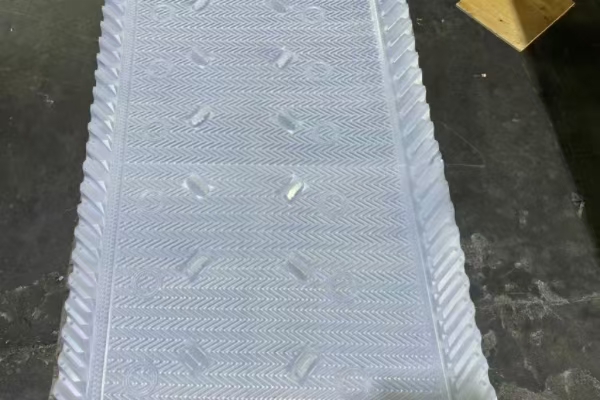
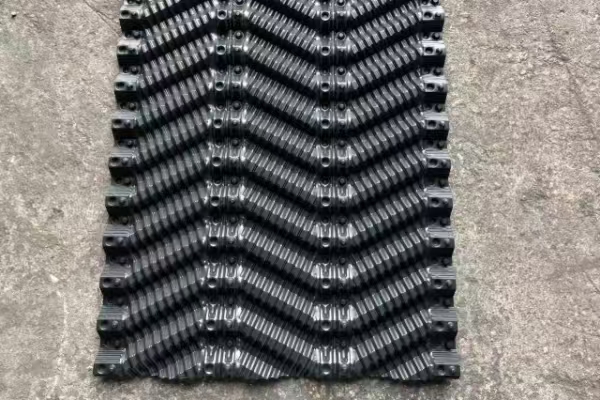
Corrugated fill is widely used because its flute structure helps create repeated contact between water and air as both move through the fill pack.
The flute angle, spacing, sheet thickness, and surface pattern can all affect the way water spreads and how easily air moves through the pack.
A smaller flute or tighter spacing can provide more contact opportunities, but it can also make the fill more sensitive to fouling. In water containing suspended solids, biological growth, or high mineral content, a very dense fill design may not always be the practical choice.
For that reason, experienced cooling tower engineers normally consider the actual water quality before choosing the fill geometry.
For projects that require a customized corrugated structure, sheet spacing, or dimensions, you can see our Corrugated Cooling Tower Fill options.
Higher Surface Area Does Not Always Mean Higher Cooling Capacity
This is probably one of the most common misunderstandings about tower fill.
Imagine two fill designs. Fill A has a higher nominal surface area, while Fill B has slightly less surface area but lower pressure drop and better resistance to fouling.
In a clean laboratory environment, Fill A may show attractive heat-transfer characteristics. But in an industrial cooling tower operating continuously for months, Fill B could maintain more of its effective performance if the water contains solids or biological contamination.
So when comparing tower fill, I would look at the complete operating picture rather than choosing the largest surface-area number.
Film Fill vs. Splash Fill for Heat Transfer
Film fill and splash fill work differently.
With Film Fill, water spreads across the surface of the fill sheets and forms thin films. This creates a large contact area within a relatively compact volume.
Splash fill breaks the water into droplets as it falls through the fill structure. It is often considered for applications where water quality, fouling, or plugging is a concern.
For clean or reasonably treated industrial water, film fill can provide excellent heat-transfer performance. For difficult water conditions, however, the resistance to fouling and ease of maintenance may become more important than maximum surface area.
How Water Quality Changes the Fill Selection
The same fill design does not work equally well in every cooling tower.
For example, a tower handling relatively clean water may use a tighter film-fill structure to maximize heat and mass transfer. A tower with a higher fouling risk may need a more open design that is easier to clean and less likely to plug.
Scale, algae, suspended solids, oil contamination, and biological growth can all reduce the effective working area of the fill.
This is also why selecting a cooling tower replacement based only on the dimensions of the old fill can sometimes lead to disappointing results. The replacement should match the tower's water quality and operating conditions as well as the physical space.
What About PVC and PP Cooling Tower Fill?
Material selection also affects long-term cooling tower performance.
PVC cooling tower fill is widely used because PVC offers a useful combination of formability, cost, and performance for many industrial applications. It is commonly used for film-fill sheets in both counterflow and crossflow towers.
PP cooling tower fill can be considered when higher temperature resistance or particular chemical compatibility requirements make polypropylene a better fit.
The correct choice depends on water temperature, chemical conditions, sunlight exposure, mechanical requirements, and the tower's operating environment.
When Should You Consider Cooling Tower Fill Replacement?
If a cooling tower suddenly loses performance, replacing the fill should not automatically be the first step. First check the fan, water flow, nozzles, basin, drift eliminators, and heat-transfer conditions.
But if the fill is heavily scaled, broken, sagging, blocked, or losing its original structure, replacement may be necessary.
Typical warning signs include:
- Higher cold-water temperature than normal
- Visible scale or biological growth on the fill
- Blocked or collapsed fill passages
- Large sections of damaged or deformed fill
- Uneven water flow through the fill pack
- Increasing fan load or airflow resistance
- Reduced cooling performance despite normal water flow
How to Choose Cooling Tower Fill for a Replacement Project
Before ordering a new fill pack, collect as much information about the existing tower as possible.
Useful information to check
- Cooling tower type: counterflow or crossflow
- Existing fill dimensions
- Fill height and number of layers
- Sheet thickness
- Flute size and spacing
- Water flow rate
- Hot-water and cold-water temperatures
- Design wet-bulb temperature
- Water quality and fouling conditions
- Available installation space
For larger industrial projects, the fill should be considered as part of the complete cooling tower system rather than as an isolated replacement component.
If you are replacing fill in an existing industrial tower, our Industrial Cooling Tower Fill page provides more information about industrial replacement and customized fill solutions.
A Practical Way to Think About Cooling Tower Fill Performance
If I were checking a cooling tower on site, I would keep the question simple:
Is the fill giving us enough effective water-air contact without creating unnecessary airflow resistance or maintenance problems?
That question is more useful than simply asking which fill has the highest surface area.
Good fill performance comes from the combination of surface area, water distribution, air movement, film formation, pressure drop, water quality, material selection, and operating conditions.
Final Thoughts
Cooling Tower Fill is one of the most important components inside an evaporative cooling tower, but its performance cannot be judged by surface area alone.
A good film fill cooling tower design needs to create effective water-air contact while keeping airflow resistance, fouling risk, water distribution, and long-term durability under control. Corrugated fill geometry, material selection, flute spacing, and operating conditions all play a role.
When selecting new Cooling Fill or planning a cooling tower replacement, the best starting point is the actual operating condition of the tower—not simply copying the old fill specification.
If you have an existing fill pack that needs to be replaced, send us the tower type, fill dimensions, water flow, and operating temperatures. We can help check the suitable fill structure and configuration for your project.
Contact us for Cooling Tower Fill replacement and customized fill solutions.