How Temperature Affects Cooling Tower Fill Material Selection
How Temperature Affects Cooling Tower Fill Material Selection
When engineers choose Cooling Tower Fill, temperature is one of those things that is easy to overlook. People often focus first on fill dimensions, pitch, surface area or price, but the operating temperature of the water can have a direct effect on which material is suitable.
This becomes especially important when selecting a film fill cooling tower for industrial process cooling or planning a cooling tower replacement.
PVC is widely used in cooling tower fill because it offers a good balance of performance, cost and availability. But when operating temperatures become higher, or when the tower experiences frequent temperature fluctuations, PP can become a more suitable option.
The important point is that material selection should be based on the actual operating conditions, not simply on which material sounds stronger.
Why Temperature Matters for Cooling Tower Fill
Cooling tower fill is continuously exposed to hot water, airflow and moisture. Its job is to maintain a large contact area between water and air while keeping the designed channels open.
As temperature increases, the mechanical properties of plastic materials can change. The fill needs to remain stable enough to maintain its original geometry and support the water distribution passing through the fill pack.
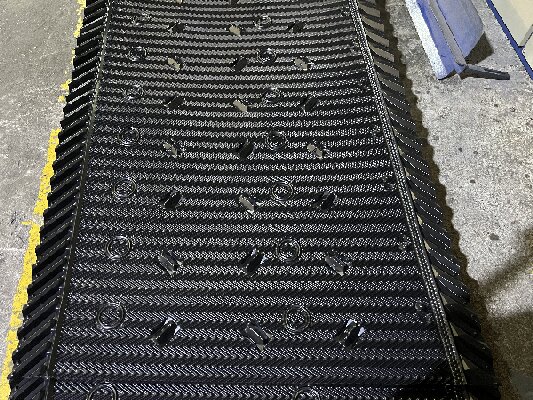
This is particularly important for Film Fill, where the shape of the corrugated sheets creates the air and water passages used for heat transfer.
If the material or fill design is not suitable for the temperature, the problem may not appear immediately. Performance can gradually become less stable as the fill is exposed to elevated temperatures over a long period.
What Happens When Cooling Tower Water Temperature Gets Higher?
There are several things worth watching when the circulating water temperature increases.
1. Material Strength Can Change
Plastic materials behave differently as temperature rises. A material that performs well at a moderate temperature may become softer or lose some of its mechanical strength at a higher temperature.
For tower fill, this matters because the sheets must retain their shape. The corrugated channels are not just there for appearance; they control how water spreads across the surface and how air moves through the fill.
2. Fill Geometry Becomes More Important
A cooling tower fill sheet has a specific flute shape, pitch and contact pattern.
If the geometry changes, even slightly, the relationship between air and water can also change. That can affect pressure drop, water distribution and heat-transfer performance.
This is why material selection should always be considered together with fill design.
3. Temperature Fluctuations Can Be More Important Than Average Temperature
This is something I would pay particular attention to on industrial projects.
A tower may normally operate at one temperature but occasionally receive much hotter process water during startup, shutdown or production changes.
Looking only at the average operating temperature can therefore give you the wrong answer.
When selecting Cooling Tower Media, check the normal temperature, maximum temperature and any possible short-term temperature spikes.
PVC Cooling Tower Fill: Where Does It Make Sense?
PVC remains one of the most commonly used materials for film fill and corrugated fill.
For many HVAC systems, commercial cooling towers and general industrial applications, PVC provides a very practical combination of cooling performance and cost.
If the operating temperature remains within the recommended range for the selected PVC fill, there may be no engineering reason to move to a more expensive material.
In fact, for a large cooling tower replacement, using a properly specified PVC fill can be a sensible choice when the existing operating conditions have not changed.
The key is to match the PVC grade and fill construction to the application rather than assuming that every PVC fill product has exactly the same performance.
When Should You Consider PP Cooling Tower Fill?
PP, or polypropylene, becomes more interesting when temperature and operating conditions become more demanding.
PP is commonly considered for applications where higher temperature capability or chemical resistance is required. This can make it useful for certain industrial process cooling systems where standard PVC may not be the preferred material.
High-Temperature Industrial Applications
Some industrial cooling systems operate with significantly higher hot-water temperatures than typical HVAC cooling towers.
In these situations, PP can be worth considering because it generally maintains useful mechanical properties at higher temperatures than standard PVC.
But don't choose PP based on temperature alone. The actual recommended operating range depends on the material formulation, sheet thickness, fill design and manufacturer specifications.
For industrial applications where temperature is one of the main concerns, you can review our PP Cooling Tower Fill options.
Temperature and Corrugated Fill Design
Material is only half of the story.
The structure of the fill also needs to match the operating conditions.
A Corrugated Fill creates a large surface area by forcing water to spread into thin films while air passes through the channels. The flute angle, pitch and sheet thickness all influence how the fill performs.
For example, a high-surface-area fill may provide excellent heat transfer under clean water conditions, but it may not be the best choice for a system with high suspended solids or a history of fouling.
Similarly, a fill design that works well at one water loading and temperature may not produce the same result under a very different operating condition.
That's why I would never specify a replacement fill simply by saying, “Give me the same size sheets.”
Check the complete fill design.
Temperature Is Not the Only Factor: Check Water Chemistry Too
High temperature and water chemistry often go together in industrial cooling systems.
As temperature increases, the interaction between water, chemicals and the plastic material can become more important. Treatment chemicals, dissolved minerals, oils and process contaminants should therefore be considered when selecting Cooling Tower Media.
This is one reason why an industrial project should not be treated exactly like a commercial HVAC tower.
Before selecting the material, try to collect:
- Normal circulating water temperature
- Maximum water temperature
- Water pH
- Water treatment chemicals
- Total dissolved solids
- Suspended solids
- Oil or process contamination
- Operating water flow
- Cooling tower type
Even a simple set of these operating details can make material selection much more reliable.
Does Higher Temperature Mean You Always Need PP?
No.
This is probably one of the most common mistakes I see when people compare cooling tower fill materials.
There is no single temperature number that automatically means “PVC is wrong” and “PP is right” for every application.
The actual decision depends on the specific material formulation, operating temperature, exposure time, fill construction and water chemistry.
For example, a tower may experience a short temperature spike that is very different from continuously operating at an elevated temperature.
So instead of asking:
“Is this temperature too high for PVC?”
It is better to ask:
“What is the recommended operating range for this specific fill, and what conditions will it actually experience?”
How Temperature Affects Cooling Tower Replacement Decisions
Temperature should also be checked before ordering replacement fill.
Sometimes a cooling tower has been operating for ten or fifteen years, and the original process conditions have changed. Production has increased, the process temperature has gone up, or the water treatment system has been modified.
If you simply replace the old fill with the same material without checking the current operating conditions, you may miss an important change in the application.
Before a cooling tower replacement project, compare the old and new operating conditions.
Questions Worth Asking Before Ordering Replacement Fill
- Has the hot-water temperature changed?
- Has the maximum temperature increased?
- Has the cooling load increased?
- Has the water chemistry changed?
- Is the existing fill showing deformation?
- Has the fill become brittle or damaged?
- Has fouling become worse?
- Has the water flow changed?
If several answers are “yes,” it may be worth reviewing the fill material and design instead of simply copying the original specification.
Industrial Cooling Tower Fill Needs a Different Approach
Industrial cooling towers are often less forgiving than smaller HVAC systems.
They may operate continuously, handle higher heat loads and work with water that contains more contaminants.
For this reason, industrial projects usually require a closer look at material selection, fill geometry and maintenance requirements.
Our Industrial Cooling Tower Fill is designed for industrial cooling applications where fill dimensions, material selection and operating conditions need to be considered together.
Temperature, Airflow and Water Flow Work Together
Another point that is easy to miss is that fill performance is not controlled by temperature alone.
A cooling tower works as a complete system.
Hot water enters the fill, spreads across the fill surface and transfers heat to moving air. The final cooling result depends on the relationship between:
- Water temperature
- Water flow rate
- Airflow
- Fill surface area
- Fill geometry
- Water distribution
- Ambient wet-bulb temperature
This means changing the fill material without considering the rest of the system may not solve a cooling problem.
If a tower is not reaching its design cold-water temperature, don't immediately assume that the fill material is the problem. Check water distribution, airflow, fouling, nozzle condition and operating load as well.
A Practical Way to Choose Between PVC and PP
If you are standing in front of a cooling tower and need to make a quick preliminary decision, I would use this simple process.
Step 1: Check the Temperature
Record both normal and maximum hot-water temperatures.
Step 2: Check the Water
Look at pH, chemicals, suspended solids, scaling and contamination.
Step 3: Identify the Tower Type
Determine whether the tower is counterflow or crossflow and check the existing fill configuration.
Step 4: Check the Existing Fill
Measure width, length, block height, pitch, sheet thickness and other important dimensions.
Step 5: Match Material and Design
Only after the operating conditions are clear should you decide whether PVC, PP or another material is appropriate.
The Bottom Line
Temperature is one of the most important factors when selecting Cooling Tower Fill, but it should not be considered by itself.
PVC is still a practical solution for many conventional cooling tower applications. When operating temperatures become higher or process conditions become more demanding, PP may provide a better material option.
At the same time, the best film fill cooling tower solution depends on more than material. Fill geometry, pitch, thickness, water loading, airflow, water quality and tower configuration all have to work together.
If you are planning a new installation or cooling tower replacement, start with the actual operating conditions rather than simply copying the old fill specification.
That small step can make a big difference to the service life and performance of your tower fill.
Need Help Selecting Cooling Tower Fill?
If you are not sure whether PVC or PP is suitable for your application, send us the existing fill dimensions, tower type, water temperature and application details.
We can help you review the material and fill structure according to the actual operating conditions.
Contact us for Cooling Tower Fill selection and replacement support