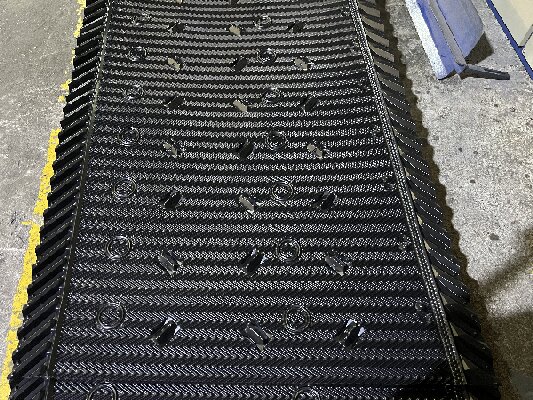
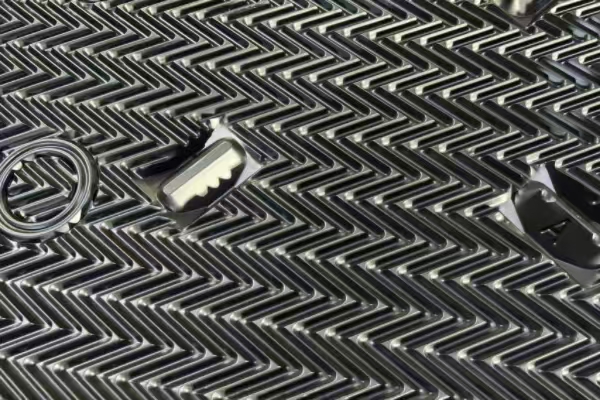
When Should You Use PP Cooling Tower Fill Instead of PVC
When Should You Use PP Cooling Tower Fill Instead of PVC?
When replacing or selecting Cooling Tower Fill, one of the first questions engineers usually ask is simple: should we use PVC or PP?
For many standard cooling towers, PVC is still a very practical choice. It is widely used for film fill cooling tower applications because it offers a good balance between cooling performance, cost, weight, and ease of manufacturing.
But there are situations where PP starts to make more sense. Higher operating temperatures, demanding industrial processes, certain chemical conditions, or unusual operating conditions can all change the material decision.
So the real question is not “Is PP better than PVC?”
It is: “Does this cooling tower actually need the advantages of PP?”
That is the question I would ask before recommending a material for a cooling tower replacement project.
PP vs PVC Cooling Tower Fill: The Basic Difference
Both polypropylene (PP) and polyvinyl chloride (PVC) can be used to manufacture film fill, corrugated fill and other types of Cooling Tower Media.
The difference becomes more important when the operating environment becomes more demanding.
| Factor | PVC Cooling Tower Fill | PP Cooling Tower Fill |
|---|---|---|
| Standard applications | Very suitable | Suitable |
| Higher temperature service | Requires careful evaluation | Often more suitable |
| Chemical resistance | Good for many normal applications | Excellent for many demanding conditions |
| Material cost | Generally lower | Generally higher |
| Industrial process cooling | Widely used | Often preferred for demanding conditions |
| Film fill applications | Common | Available |
This is only a starting point. The actual operating temperature, water chemistry, fill design, sheet thickness, airflow, water loading and tower configuration should all be considered before making the final decision.
When Is PVC Cooling Tower Fill Still the Right Choice?
Let's start with PVC, because there is a good reason it remains so common.
If the cooling tower operates under normal conditions and the circulating water temperature is within the recommended range of the selected product, there may be no practical reason to change to PP.
A well-designed PVC Film Fill can provide excellent water-to-air contact and efficient heat transfer. For many HVAC systems, commercial buildings and general industrial cooling applications, this is exactly what you need.
Choose PVC When the Operating Conditions Are Moderate
If your system has relatively stable water temperatures, controlled water chemistry and a normal maintenance program, PVC can provide a very good balance between performance and cost.
This is especially important for large cooling tower replacement projects. When hundreds or thousands of cubic meters of fill need to be replaced, material cost can become a significant part of the project budget.
In this situation, choosing a more expensive material without a clear engineering reason may not provide much additional value.
For standard applications, you can review our PVC Cooling Tower Fill options for different cooling tower configurations.
When Should You Consider PP Cooling Tower Fill?
PP becomes more interesting when the operating environment starts moving beyond normal cooling tower conditions.
There are three questions I normally ask first:
- How hot is the circulating water?
- What chemicals are present in the water?
- What happens when the process operates outside its normal conditions?
If the answer to one or more of these questions raises concerns about PVC, PP deserves a closer look.
1. Higher Water Temperature
Temperature is probably the most important reason to consider PP.
Every plastic material has an operating temperature range. As temperature increases, the mechanical properties and dimensional stability of the material can change.
This matters because tower fill has to maintain its shape while water is continuously flowing through the channels.
If the material becomes too soft or loses dimensional stability, the fill geometry can change. Once the channels become distorted, airflow and water distribution can also be affected.
PP generally offers a higher temperature capability than standard PVC, which is why it is often considered for higher-temperature industrial cooling applications.
However, don't make the mistake of choosing PP simply because someone says the water is “hot.”
Check the actual operating temperature, normal temperature, maximum temperature and possible process temperature spikes. Then compare those values with the manufacturer's recommended temperature range for the exact fill construction.
2. More Demanding Chemical Conditions
Water chemistry is another reason PP may be considered.
Industrial cooling systems can contain treatment chemicals, dissolved minerals, acids, alkalis, biocides and process contaminants. The compatibility of the fill material depends not only on the chemical itself, but also on concentration, temperature and exposure time.
PP has strong chemical resistance and can be attractive in applications where the water chemistry is more demanding.
But there is an important point here:
Never select PP simply because “PP is chemical resistant.”
Give the fill manufacturer the actual water chemistry whenever possible. A proper material recommendation should consider the specific chemicals and their concentrations rather than relying on a general material comparison.
3. Industrial Process Cooling
Not every industrial cooling tower needs PP.
But process cooling can be very different from a typical HVAC cooling tower.
In a process cooling system, the heat load may fluctuate considerably. Water temperatures can be higher, the water chemistry can be more complicated, and an unexpected process condition may expose the fill to conditions that a normal HVAC tower never experiences.
That is where the additional temperature and chemical resistance of PP can become valuable.
In other words, PP is not simply a “premium version” of PVC. It is a material that can make more sense when the operating conditions justify it.
Does PP Cooling Tower Fill Cool Better Than PVC?
This is where I would be careful with product comparisons.
PP does not automatically mean better cooling performance.
The heat-transfer performance of a Film Fill depends on much more than the plastic material. Fill geometry, flute design, specific surface area, sheet thickness, water loading, airflow, water distribution and operating conditions all play important roles.
A well-designed PVC film fill can perform extremely well in the application it was designed for.
Likewise, PP can provide excellent cooling performance when the fill design and operating conditions are properly matched.
So when comparing two products, don't look only at “PVC vs PP.”
Compare the complete fill specification.
Material Is Only One Part of Cooling Tower Fill Selection
This is something that is easy to overlook during a cooling tower replacement.
Sometimes the old fill is removed and replaced with a new product based only on dimensions. The new sheets physically fit inside the tower, so everyone assumes the replacement is correct.
But the material is only one part of the selection.
Check the Fill Pitch and Flute Design
A narrow-pitch Corrugated Fill can provide high surface area, but it may also be more sensitive to suspended solids, scaling and biological fouling.
A wider channel design may be more appropriate when water quality is poor or the tower has a history of fouling.
The best Cooling Tower Media is therefore not necessarily the product with the highest theoretical surface area. It is the product that can maintain useful heat-transfer performance under the actual water and air conditions in your tower.
Check the Existing Tower Before Replacement
Before ordering replacement fill, check:
- Existing fill dimensions
- Counterflow or crossflow configuration
- Water temperature
- Design water flow
- Airflow conditions
- Fill pitch and channel size
- Water quality and fouling history
- Support structure and loading
- Required fire and material specifications
This information makes it much easier to decide whether PVC or PP is appropriate.
PP or PVC: A Simple Engineering Decision
If I had to simplify the decision for a project discussion, I would look at it this way.
PVC Is Usually Worth Considering When:
- The cooling water temperature is within the recommended PVC operating range.
- The water chemistry is reasonably controlled.
- The tower is used for normal HVAC or general industrial cooling.
- Project cost is an important consideration.
- The existing tower was originally designed around PVC fill.
PP Is Worth Considering When:
- The operating water temperature is relatively high.
- There are frequent temperature peaks or process fluctuations.
- The water contains chemicals that require careful material compatibility evaluation.
- The cooling tower is used for demanding industrial process cooling.
- The additional material cost is justified by the operating conditions.
For higher-temperature or more demanding projects, you can review our PP Cooling Tower Fill for a material option specifically designed around these requirements.
What About UV Exposure?
There is another point worth mentioning when selecting plastic fill: the actual environment around the tower.
If the fill or other plastic components are exposed to sunlight during storage, installation or operation, UV exposure should be considered as part of the material specification.
This does not mean that PP should automatically replace PVC outdoors. UV resistance depends on the formulation, additives, product construction and actual exposure conditions.
For outdoor projects, ask the manufacturer whether the selected fill has the required UV protection rather than making the decision based only on the word “PP” or “PVC.”
Don't Choose PP Just Because It Sounds More Heavy-Duty
This is probably the most practical advice I can give.
I've seen projects where PP is specified simply because it sounds stronger or more advanced than PVC.
But if the tower operates under normal conditions, a properly designed PVC fill may already provide everything the system needs.
On the other hand, I've also seen replacement projects where the original material was selected without considering higher process temperatures. In those cases, saving money on the fill material can become expensive later.
The right material is the one that matches the actual operating conditions.
PP vs PVC for Cooling Tower Replacement
For a replacement project, don't start with the question “How much does PP cost compared with PVC?”
Start with the tower.
Look at the existing fill, operating temperatures, water quality, process conditions and cooling requirements. Then determine which material and fill design can provide stable performance for the expected service life.
If the existing PVC fill has lasted well and the operating conditions have not changed, replacing it with a similar PVC design may be completely reasonable.
If the process has become hotter, the water chemistry has changed, or the operating conditions are more demanding than before, it may be time to consider PP.
Final Thoughts: When Should You Use PP Instead of PVC?
There is no universal answer to the PP vs PVC question.
PVC Cooling Tower Fill remains a practical and cost-effective option for many conventional cooling towers. PP becomes more attractive when higher temperature resistance, chemical compatibility or demanding industrial operating conditions become important.
More importantly, material should never be considered separately from the fill design.
A good film fill cooling tower solution needs the right material, flute geometry, pitch, thickness, water loading and airflow conditions working together.
So before you specify a new Cooling Tower Fill, ask one simple question:
What does the tower actually need?
That answer is usually more useful than simply choosing the material with the longer list of advantages.
Need Help Choosing the Right Cooling Tower Fill?
If you are working on a new tower, industrial cooling project or cooling tower replacement, you can send us your existing fill dimensions, tower type, water temperature and application details.
We can help you compare PP and PVC options and recommend a suitable fill structure according to your operating conditions.