Why Cooling Tower Fill Selection Matters in Southeast Asia
Why Cooling Tower Fill Selection Matters in Southeast Asia
Southeast Asia is one of the most demanding regions for industrial cooling systems. High ambient temperatures, heavy rainfall, strong sunlight, high humidity, and challenging water quality can all affect cooling tower performance. In many projects, operators focus heavily on fans, motors, pumps, and water treatment, but sometimes overlook one of the most important components inside the tower: the Cooling Tower Fill.
The right cooling tower fill can help improve heat transfer efficiency, reduce energy consumption, and extend the operating life of the cooling tower. On the other hand, choosing the wrong Cooling Tower Media may lead to fouling, scaling, poor airflow, higher water temperatures, and frequent maintenance.
For industrial users in Southeast Asia, cooling tower fill selection is not simply about choosing the cheapest PVC sheet. It is about matching the fill design to the local climate, water conditions, cooling tower type, and operating environment.
Why Southeast Asia Creates Special Challenges for Cooling Tower Fill
Cooling towers in Southeast Asia often operate under conditions that are more demanding than those in cooler and drier regions. The combination of heat and humidity means the cooling system may need to operate continuously for long periods.
At the same time, many industrial facilities face water quality challenges. Depending on the location and industry, circulating water may contain minerals, suspended solids, biological contaminants, or process-related impurities.
From practical experience, the main challenges usually include:
- High ambient temperatures
- High humidity throughout the year
- Strong UV exposure for outdoor cooling towers
- Heavy rainfall and seasonal weather changes
- Scaling caused by minerals in circulating water
- Algae and biological growth
- Dust and suspended solids from industrial environments
- Continuous operation with limited shutdown time
Because of these conditions, selecting the right tower fill becomes an important engineering decision rather than a simple replacement purchase.
Cooling Tower Fill Is Where Most of the Heat Transfer Happens
The basic job of cooling tower fill is simple: create as much effective contact area as possible between water and air.
When hot circulating water flows over the surface of the fill, it spreads into thin films. Air moves through the fill structure, allowing heat to transfer from the water into the air.
A well-designed film fill cooling tower system can significantly increase the effective heat transfer area inside a relatively compact tower.
However, more surface area is not always better.
This is where many buyers make mistakes. A fill with very small channels may provide excellent theoretical heat transfer performance, but if the circulating water contains dirt, scale, or biological growth, those narrow passages can become blocked.
For Southeast Asian applications, the best solution is often a balance between:
- High cooling efficiency
- Good airflow
- Reasonable channel spacing
- Resistance to fouling
- Easy maintenance
- Long service life
Film Fill or Splash Fill: Which One Works Better?
There is no universal answer. The correct choice depends largely on water quality and operating conditions.
Film Fill
Film fill is widely used in modern industrial cooling towers because it provides a large heat transfer surface within a compact space.
Water flows across the corrugated sheets and forms a thin film. This increases the contact area between water and air and improves cooling efficiency.
Film fill is usually a good choice when:
- Water quality is reasonably controlled
- High thermal efficiency is required
- Space inside the cooling tower is limited
- The tower operates continuously
However, if the system has serious fouling problems, the fill geometry should be selected carefully. Choosing an extremely narrow flute design may create unnecessary maintenance problems.
Splash Fill
Splash fill works differently. Instead of forming a continuous water film, it breaks the water into droplets as it passes through the fill layers.
It generally offers better tolerance to dirty water, although the cooling efficiency per unit volume may be lower than high-efficiency film fill.
For industrial systems with poor water quality, some operators may prefer a more open structure rather than simply choosing the highest surface-area fill available.
Why Corrugated Fill Design Matters
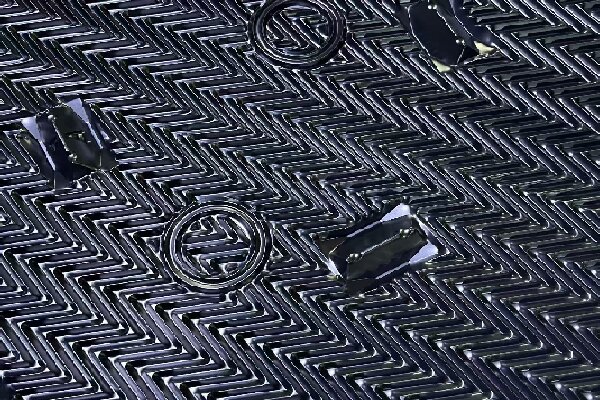
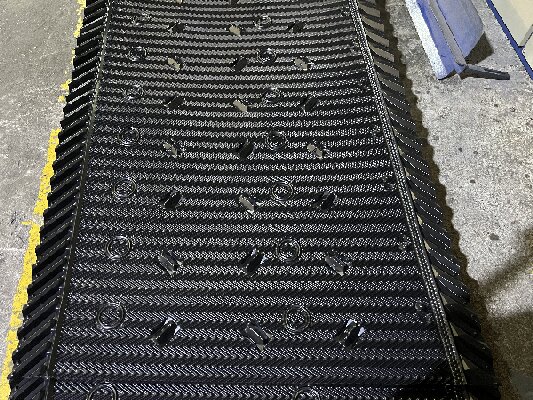
Corrugated fill is one of the most common structures used in cooling tower applications. The corrugated surface helps distribute water and create turbulence as water flows downward.
Different corrugation angles, flute heights, and channel designs can significantly influence:
- Water distribution
- Heat transfer efficiency
- Air resistance
- Fouling tendency
- Mechanical strength
A well-designed corrugated structure should provide enough surface area for heat exchange while maintaining sufficient airflow passages.
For industrial cooling towers operating in challenging environments, engineers should pay attention not only to sheet thickness but also to the actual geometry of the fill.
For applications requiring efficient water distribution and stable structural performance, Corrugated cooling tower fill can be a practical option for many industrial cooling tower replacement and retrofit projects.
Counterflow and Crossflow Towers Need Different Fill Designs
One common mistake during a cooling tower replacement project is assuming that all fills can be used interchangeably.
In reality, the airflow direction and tower configuration should be considered carefully.
Counterflow Cooling Towers
In a counterflow tower, air moves upward while water flows downward.
The fill must provide efficient contact between the opposing flows while maintaining acceptable pressure drop.
Counterflow systems often use vertically arranged film fill designs optimized for this airflow pattern.
Crossflow Cooling Towers
In a crossflow cooling tower, air moves horizontally across the falling water.
The fill arrangement and water distribution system are different from counterflow towers, which means the fill design should also be selected accordingly.
Before ordering cooling fill for replacement, it is important to confirm:
- Cooling tower type
- Airflow direction
- Existing fill dimensions
- Support grid design
- Water distribution method
These details may sound basic, but they can prevent expensive installation problems later.
Material Selection: PVC or PP?
Material selection is another important factor, especially in Southeast Asia where operating temperatures and chemical conditions can vary widely.
PVC Cooling Tower Fill
PVC is widely used for cooling tower applications because it provides good mechanical properties, corrosion resistance, and cost efficiency.
For many standard industrial cooling towers, PVC remains a practical and reliable choice.
However, not all PVC cooling tower fill is the same. Sheet quality, thickness, forming process, bonding strength, and temperature resistance should all be considered.
PP Cooling Tower Fill
Polypropylene is generally more suitable for applications involving higher operating temperatures.
Although PP may have a higher material cost, it can be a better choice for certain industrial processes where standard PVC operating limits may be exceeded.
The right material should always be selected based on actual operating conditions rather than simply choosing the lowest-cost option.
Fouling Is a Major Issue in Southeast Asian Cooling Towers
In many industrial cooling systems, fouling is a bigger problem than initial cooling performance.
Scale, algae, bacteria, dust, and suspended solids can gradually accumulate inside the fill passages.
As fouling increases, several problems may appear:
- Reduced water flow through the fill
- Blocked air passages
- Higher fan energy consumption
- Reduced cooling capacity
- Increased maintenance requirements
- Higher outlet water temperature
In other words, a high-performance fill can become a low-performance fill if the water quality is not compatible with its channel structure.
For systems with a higher fouling risk, buyers should consider more open fill designs instead of focusing only on maximum surface area.
UV Resistance Should Not Be Ignored
Many cooling towers in Southeast Asia are installed outdoors and exposed to strong sunlight for years.
Long-term UV exposure can gradually affect the physical properties of some plastic materials.
For outdoor installations, UV resistance should be considered during the material selection process, particularly for towers located in open industrial areas with continuous sun exposure.
This is especially important for cooling tower replacement projects where the new fill is expected to operate for many years without frequent shutdowns.
Cooling Tower Replacement: Don't Simply Copy the Old Fill
When planning a cooling tower replacement, many buyers simply measure the existing fill and order the same dimensions.
That is understandable, but it may not always be the best approach.
The old fill may have been selected many years ago when operating conditions, production capacity, or water treatment systems were different.
A replacement project is actually a good opportunity to review whether the existing design is still suitable.
Before ordering new Cooling Tower Media, try to evaluate:
- Has the cooling load increased?
- Has the circulating water quality changed?
- Is fouling becoming more serious?
- Are energy costs higher than before?
- Does the existing fill frequently collapse or deform?
- Has the cooling tower experienced a loss of thermal performance?
Sometimes changing the fill profile or material can provide better long-term performance than simply duplicating the old design.
Why Fill Blocks Can Make Installation Easier
For some retrofit projects, installation efficiency is just as important as thermal performance.
Cooling tower fill supplied in properly designed blocks can simplify handling and installation inside the tower.
However, block dimensions should always match the internal structure of the cooling tower.
Factors such as support beam spacing, tower access doors, and installation space should be considered before production.
What Buyers Should Check Before Ordering Cooling Tower Fill
If you are sourcing Cooling Tower Fill for a project in Southeast Asia, I would recommend preparing a few basic details before contacting suppliers.
- Cooling tower type: counterflow or crossflow
- Existing fill dimensions
- Required flute height
- Sheet thickness
- Material: PVC or PP
- Maximum operating temperature
- Water quality information
- Fouling or scaling problems
- Required quantity
- Installation method
The more information you provide, the easier it is to select a suitable tower fill instead of relying on a generic quotation.
For standard and industrial applications, Industrial cooling tower fill can be considered when evaluating replacement or retrofit solutions for large industrial cooling systems.
A Simple Rule: Don't Buy Fill Based on Price Alone
Cooling tower fill is often treated as a consumable component, so buyers naturally compare prices.
Price is important, but the cheapest fill is not always the lowest-cost solution.
A poorly selected fill can create hidden costs through:
- Higher energy consumption
- Reduced cooling capacity
- Frequent cleaning
- Shorter replacement cycles
- Production interruptions
A slightly better fill design that matches the actual operating environment may provide better value over its service life.
Final Thoughts
Choosing the right Cooling Tower Fill is particularly important in Southeast Asia because local operating conditions can be challenging. High temperatures, humidity, strong sunlight, and varying water quality all influence how long a fill will perform effectively.
The best solution is not always the fill with the highest surface area or the lowest price. In most cases, the right choice is a balance between cooling efficiency, fouling resistance, material performance, airflow, and maintenance requirements.
If you are planning a new project or considering a cooling tower replacement, reviewing the tower design and operating conditions before ordering can save a lot of trouble later.
Need help selecting the right film fill, Corrugated fill, PVC or PP cooling tower media for your project? Contact us with your cooling tower specifications, and our team can help evaluate a suitable fill solution based on your application.